








For the halftime show on Super Bowl Sunday, Bad Bunny, a Puerto Rican singer, performed a Spanish-language-dominant show. This news alone created many different opinions about whether they should have chosen an English-speaking singer or if it was even going to be enjoyable considering it would be in Spanish. One thing is certain, though: English is not America’s first language either.
However, one opinion in particular made itself heard. Turning Point USA created its own “All-American halftime show.” Bad Bunny represented Latin America in a beautiful artistic way while also delivering a clear, peaceful political message: We all are America, not just the United States.
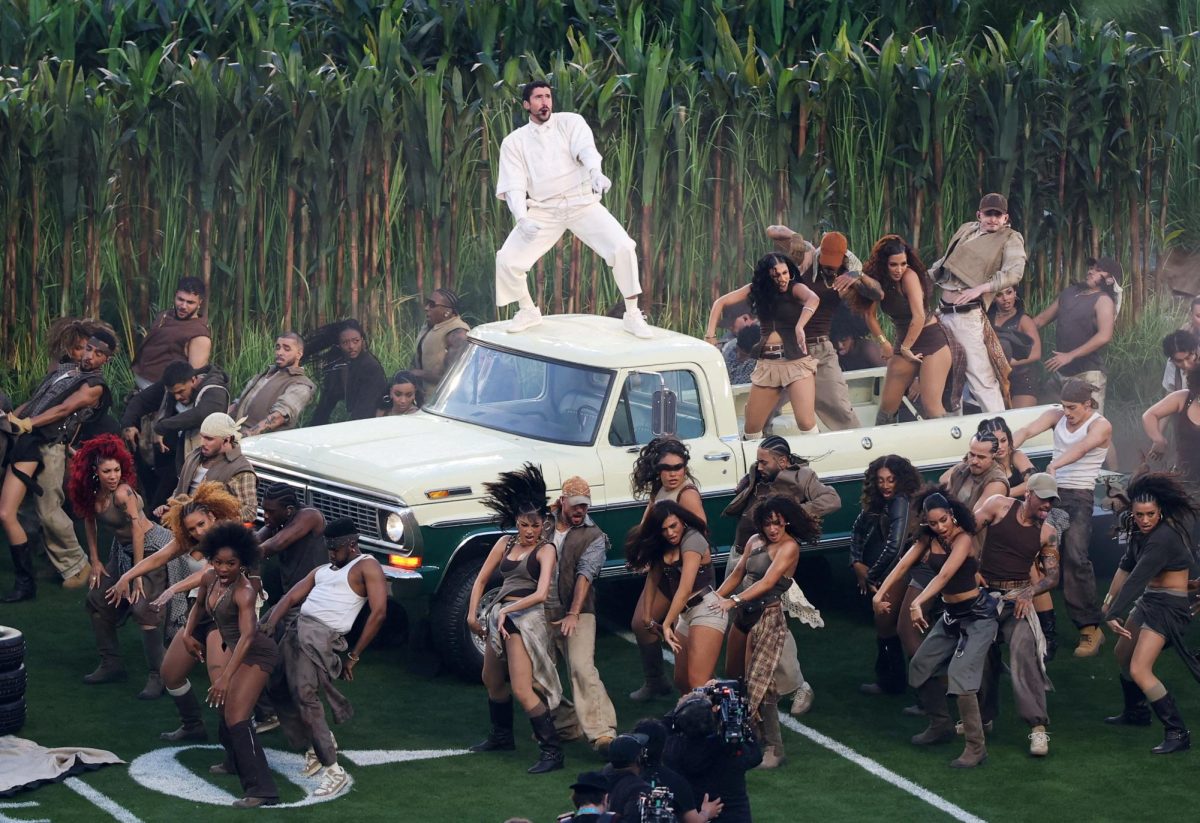
To begin, Benito opened the show performing Tití Me Preguntó. He appeared in what seemed to be a field surrounded by agricultural workers. This specifically represents the sugar and fruit farms in Puerto Rico. As the performance continued, he showed a classic street food cart for coco frío, followed by a group of men playing dominoes together, a nail technician doing a woman’s nails, women posing for the camera with construction blocks behind them, a piraguas and tacos food cart, two box players, and finally a jewelry shop.
These elements were not simply placed there to fill space; they represented the Latino community. These are occupations commonly seen among Latinos in the United States: selling food from carts like in one’s home country, grandparents playing dominoes in the streets while enjoying their evenings, construction workers, and more. Bad Bunny placed Latino hardworking people in the spotlight so they could be recognized.
Next, in the “casita,” a replica of a house, many Latino celebrities appeared, such as Cardi B, Pedro Pascal, Young Miko, Karol G, and others. This created an even broader representation of diversity since they are not Puerto Rican like Benito.
Bad Bunny also stated (in Spanish), “My name is Benito Antonio Martínez Ocasio, and if I’m here at the LX Super Bowl, it is because I never, never, stopped believing in myself. You should also believe in yourself. You are worth more than you think,” during his performance. This served as encouragement for people to keep dreaming, follow their hearts, and continue working hard for what they want.
After his statement, the camera focused on a wedding taking place. It turned out to be a real wedding, where Lady Gaga performed Die With a Smile in a salsa version. This scene showed more than just a wedding; it displayed unity, joy, warmth, the combination of two worlds, and the beauty that can come from it.
Right after that song, Bad Bunny performed Bailando Inolvidable, saying the famous quote from the song: “While one is alive, one must love as much as one can.” Love was visible everywhere in the scene: families dancing together, the happy couple cutting the cake, little kids running around, and the—at least for Latinos—unforgettable moment of a child sleeping across two chairs. This moment represented a shared experience among many Latinos: falling asleep in the middle of a long party and turning two chairs into a temporary bed. Benito also said, “Dance without fear. Love without fear,” a heartwarming message during difficult times for Latinos in the United States.
Gabriel Effio, a sophomore band major, commented, “I thought it was really inspiring to spread love instead of hate in this world that’s full of hatred.” Bad Bunny achieved his goal, as the hearts of many were moved by this moment.
NUEVAYoL was the next song he performed. It showed people dancing with a background filled with history: a minimarket called “La Marqueta,” a barbershop, and a special moment when Benito approached one of the store replicas. On camera appeared Toñita, the owner of the Caribbean Social Club in Williamsburg, New York. Bad Bunny mentions her in his song and helped fundraise to keep her business afloat.
Right after this, the camera focused on a child sitting with his family watching an old television, showing the Grammys where Bad Bunny gave his speech. Then Benito appeared and handed the Grammy to the little boy, whom many viewers believed represented his younger self.
Unexpectedly, after the heartwarming scene before, Ricky Martin, another Puerto Rican singer, performed one of Bad Bunny’s songs from his latest album: Lo Que Le Pasó a Hawaii. The song supposedly came to Benito in a dream and was unexpected to hear because the lyrics state, “They want to take away my river and my beach too. They want my neighborhood and for Grandma to leave. No, don’t let go of the flag or forget the lelolai, because I don’t want them to do to you what happened to Hawaii.” The song expresses concern that Puerto Rico, like Hawaii, could eventually face further colonization and lose its essence.
The camera then switched again, revealing electric poles with people climbing them alongside him. This symbolized the frequent power outages that Puerto Rico experiences. As he did this, he performed El Apagón, which translates to “The Power Outage,” a song that criticizes the negligence and disregard shown by both the Puerto Rican and U.S. governments toward the island.
His final song was DTMF, a powerful and emotional song about missing someone who has passed away and wishing you had taken more pictures with them while they were alive. During this heartfelt moment, viewers could see almost all the North and South American flags, with people proudly holding their countries’ flags. It was a beautiful moment of cultural unity.
To close his performance, Benito Antonio Martínez Ocasio mentioned all the countries in the Americas, clearly emphasizing that America is a continent, not a single country, and therefore, we are all America.
This performance was meant to be entertainment, yet it became much more than that. In a 13-minute show, Bad Bunny delivered a powerful message, reaffirming that the only thing more powerful than hate is love. In doing so, he showed how, for many Latinos, love is present in everything we do.
The question of whether music is political is almost humorous. The real question should be: how many times has music been created to express an artist’s personal opinions, especially political ones? The answer is many, many times.
In this performance, however, it is fair to say that Bad Bunny delivered a peaceful and heartwarming political message through unity and love—something that the United States greatly needs right now.