














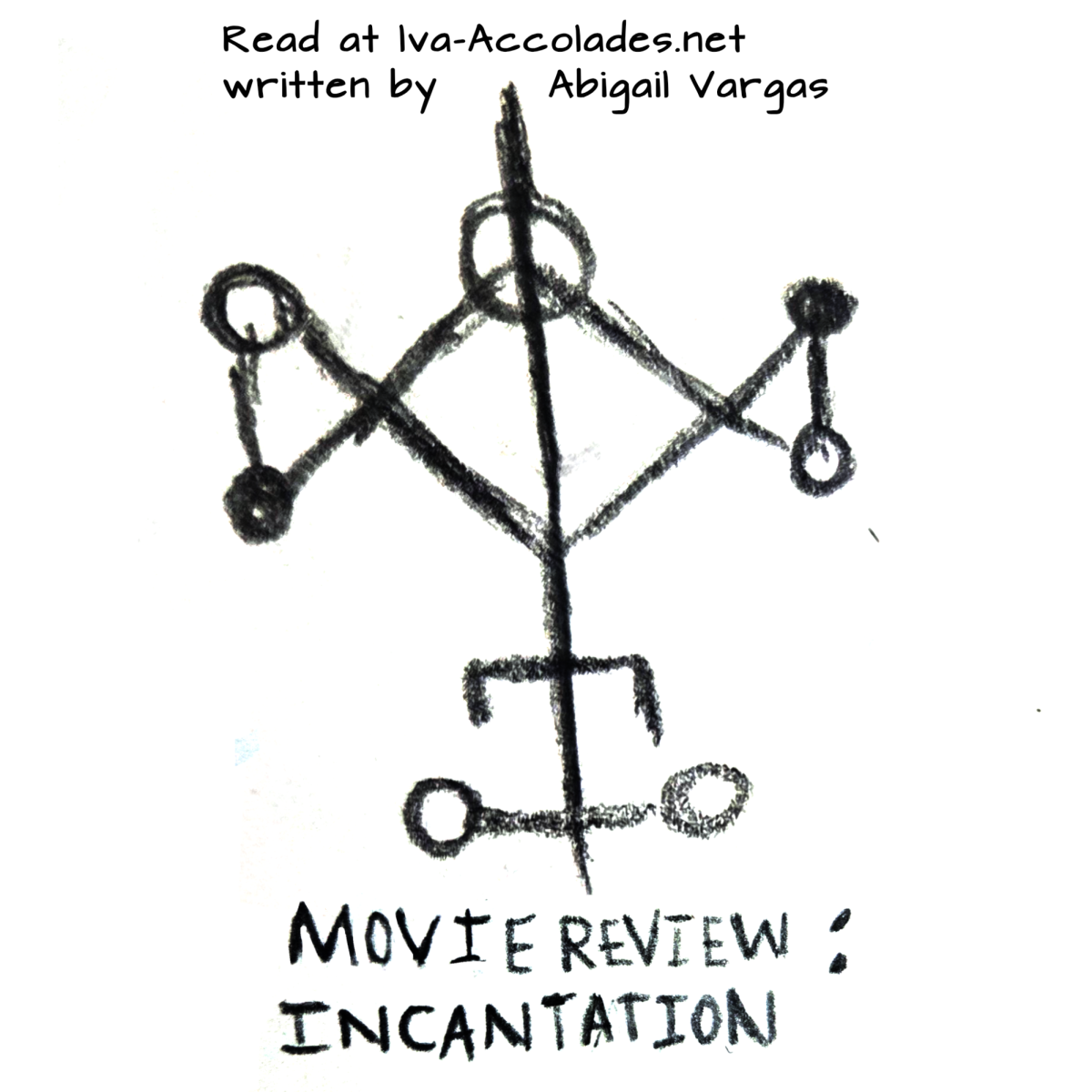
Incantation can best be described as a found-footage horror film deriving from religious and cult-like themes to give most audiences goosebumps. In the start of the movie, the main character, Li-Ronan, directly addresses the audience starting off with active participation in using your mind to change the direction of an optical illusion. Afterwards, she describes that no matter what kind of things you wish on others, the intention of it can change. Later on, Ronan adds on more to the story by telling the audience that she has been cursed by invading a religious sanctuary, and therefore her daughter is at risk of being haunted by the taboo force. Li-Ronan addresses the audience again, asking the audience to perform a ceremony of looking at a symbol, and repeating a phrase verbally or consciously to help her daughter. The phrase is “Hou-ho-xiu-yi, si-sei-wu-ma.”
The film mixes between her retelling of the events with additional cutbacks to the present time. Half of the scenes consist of Ronan reuniting with her child and the events that ensue after Ronan is connected to a new person, while the other half consists of Ronan and her violating the sanctuary of Mother Buddha. There are no exact details pertaining to the period between Ronan meeting her child, Dodo, and the period of the invasion of the tunnel six years ago. Most of what can be concluded is severe depression, anxiety, and paranoia led Ronan to isolate herself in order to recollect her mind from the events six years ago.
The retelling of what happened six years ago, was before Dodo was born. It shows footage of Ronan and two other people named Yuan and Dom, on a channel called Strange Murmurs. They decide to travel up a strange mountain to go up to a tunnel that is pronounced to be warned not to enter, in hopes of making their own superstitious accounts of the tunnel. They continue on the drive to stop at a small village, to which both Dom and Yuan are connected to from their granduncle living here. Only Dom and Yuan enter the tunnel when they finally get the chance to. Ronan is tasked to stay outside to keep the little girl from the village safe who has now been displayed sleeping in the front of the gated tunnel. Shortly after, Ronan suddenly bleeds from below, which would mean she miscarried. This is not the case, as Dodo was born, and was most likely done by Mother Buddha to make Ronan fearful of miscarrying.
The scenes of Ronan and her daughter are of the present. She meets her daughter, separated at an unspecified time due to Ronan’s inability to care for a child. Li-Ronan also meets Dodo’s caretaker, who claims that Dodo calls him dad, coming to show that the two have already established a parental relationship while Dodo has been waiting for her real mother, Li-Ronan, to be able to take care of her. As soon as Dodo is home, it means her exposure to Ronan’s curse is beginning to form. It is a kind of curse where misfortune is spread to others. Dodo becomes troubled at preschool. Dodo faces things like the Baddie, an “imaginary” figure which tells her to do certain things that endanger her.
The climax of the film is when Ronan decides to give all Dodo’s belongings back to foster care, and decides to enter the tunnel again. In the tunnel, she puts each item to where it belongs, the lock of hair put amongst the other locks of hairs on the plate, a tooth placed on the empty spot of the third tooth placement. She then ventures further to find the statue of Mother Buddha, gives her final message to Dodo, and films the reveal of Mother Buddha’s face behind the cloth which covered her. In the end, Ronan kills herself under the power of Mother Buddha. The audience of the film is cursed to say the phrase and pass it onto others, has seen the symbol and knows its meaning, and has seen the face of Mother Buddha, the heart of the curse.
I enjoyed this film a lot. I felt that there were many scenes that gave so much information, without telling the audience exactly what was the truth until the very end. In general, it is hard for most people in the film industry to be able to portray an unreliable narrator, as It can be difficult to balance giving the audience the truth, as well as portraying the lie the narrator is giving. But in this film, it gives enough of the correct and incorrect information that makes the audience susceptible to believing that the narrator, which makes the information used as the truth as well. A key detail which made this effective was from the beginning of the movie. The audience is inclined to participate in the chants and to memorize the details of the symbol because the narrator is able to make herself seem as innocent by not giving the retelling yet. The phrase that Ronan says in the beginning of the film, and what the villagers say, “Hou-ho-xiu-yi, si-sei-wu-ma” is actually a curse of “sharing.” What is being said in the phrase is “I wish to share this curse and offer up my name.” The symbol is meant to be a spell for dispensing the curse onto strangers. The more the curse is spread out, the more diluted the curse is on the person who is cursed. The more that is known about the deity of the curse, the more misfortune is brought upon that person.The same participation of reading the phrase in the end can now be seen in a different light. The audience understands that after watching the footage and discovering the curse, that they were unconsciously cursing themselves the entire time. It helps to get the audience engaged in the work beyond the veil of truth that this is a make-believe story.
Another good component of the film can be its symbolism. Most of the symbolism in the story is what drives the theme of the entire movie. We can easily connect to the relationship between Ronan and Dodo as to what mothers would do for their children. It’s heavily emphasized in the story how Ronan keeps coming to the next big step, attempting her best to beat whatever obstacle there is with the next best solution. Dodo eats an herb from a person helping Ronan, and Ronan is told by the person to not feed Dodo for seven days. Because it is seven days of starving her own child, Ronan ends up feeding her pineapple (Dodo’s favorite fruit) in order to not see her daughter suffer. She gives Dodo pineapple because she does her best to find a solution where it meets her daughter’s comfort and the well-being of Dodo against Mother Buddha’s curse. And in the very resolution of the story, we come to see that Ronan is willing to sacrifice her own life for her daughter’s life. This can also be applied to Dodo’s caretaker, who decides to uncover the footage in the tunnel even if it meant risking his life, all for Dodo. These two characters’ drive to save Dodo proves the theme that good parents will do all that they can for their children.
Another note I made in the movie was the usage of gender that came into place. There are various instances in the movie where women in any role are targeted. I’d like to assume that this is because in general, women of all roles, regardless of age and situation, are of the minority. The child in the movie who was a part of the village was the village’s main connection to Mother Buddha. In the movie they pass by a room of a girl who Dom and Yuan do not relate to, whose back is being painted with words. They ask to enter the tunnel that is at the village, but the granduncle forbids them to. Later on in the night, they sneak outside to find the villagers all chanting the common phrase ritualistically and surrounding the child. She was an open sacrifice offered to Mother Buddha, while there were many people of the village apart of the cult who were majorly male figures. I feel that this can hint towards women’s oppression and the hierarchical system that men are of higher status, while women are of the lower. What the movie does well in emphasizing this, is the fact that Ronan, having experienced the tunnel in person, keeps having to explain the story to people who do not believe her because her story is unusual. She displays extreme measures of discomfort and panic about this tunnel, while others take this expression with a grain of salt. Her experience at the medical center with Dr. Wu is clearly treated in such a manner simply because the doctor doesn’t believe her story, and because women are often taken less seriously. Even the experience during the events of the tunnel is inherently dismissive of the care that Ronan needs. The group is caught after Ronan is led by the little girl into a cottage full of Buddha statues, and a painting with Mother Buddha. It’s at this moment when the group is caught that the group realizes Ronan is pregnant. Ronan keeps on vomiting at different points in time during their trip to the village. This is dismissed again when they finally sneak out to the tunnel. They do not stop their endeavors to enter the tunnel and neither of the men remain there to care for her. What this can symbolize is the idea of temptation that people have towards vices. They leave Ronan to the tempting tunnel, which realistically provides little to no reward. It resembles the common doing of young men leaving their partners either emotionally or physically once responsibility over a child appears. This problem of women being dismissed by men or any other character simply because they are women is repeated through the movie. However, what the movie does to break this ideology is by making Ronan an independent character throughout the film. Despite dealing with the hardships of being a woman, Ronan is the exact opposite representation of what is expected in that lower hierarchical system placed on women. She is an independent woman balancing both her mental well-being as well as balancing raising a daughter by herself. She comes to solve the problem for herself anyway rather than having to rely on a man’s status or stature for help. What follows on this status can also be directed to Mother Buddha. While Mother Buddha is of the higher being and status all around the story, it can be seen as a form of conformity in the hierarchical system. Mother Buddha’s curse is granted to be a figure feared by man. But what can be fear can also be a form of hatred in disfiguring what that person is like. Mother Buddha’s scary narrative can derive from man’s own distortion of her being. And Ronan, an independent woman, faces Mother Buddha. Even if Ronan passed away, she lived knowing that she did all that she could for her daughter, while retaining her righteous independence.
Incantation is a wonderful story that can be summarized in a few sentences. It is about a mother willing to do whatever she can to protect her daughter. It is what a parent is willing to do for their child. That good parents will do anything. Incantation is a great horror film that can bring chills amongst many crowds. Incantation is a film that can veil itself on terrifying themes, while making key points that make up a larger picture beyond a scary goddess.